Poverty's Impression on a Kid's Psychological Well being
Newest Psychological Well being Information
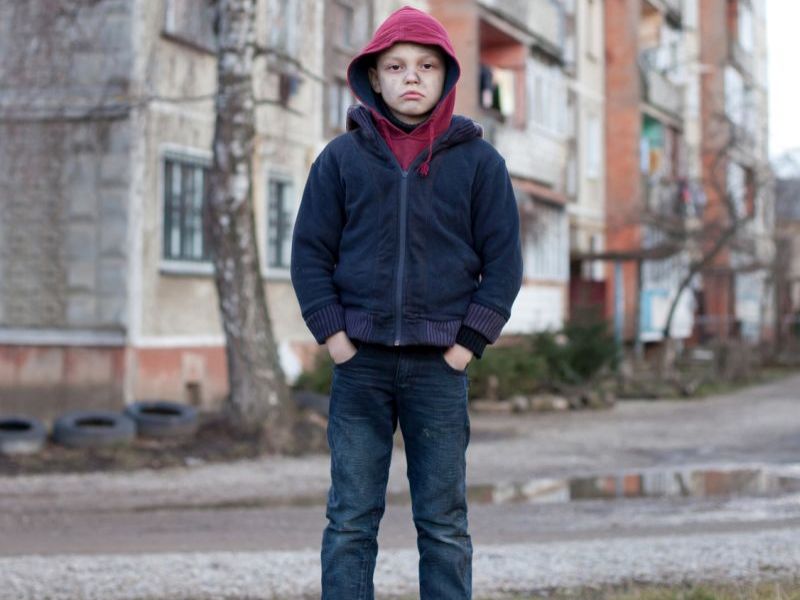
MONDAY, Jan. 9, 2017 (HealthDay Information) -- Rising up in poverty exposes kids to better ranges of stress, which may result in psychological issues later in life, a brand new examine suggests.
Researchers at Cornell College reported that children who develop up poor usually tend to have decreased short-term spatial reminiscence. The examine additionally reported that such children appear to be extra liable to delinquent and aggressive conduct, akin to bullying.
Poor kids are additionally extra possible than children from middle-income properties to really feel powerless, the examine authors instructed.
After all, the findings do not imply that every one kids rising up in poverty can have these issues, solely that the chance is greater, the researchers mentioned.
"What this implies is, if you happen to're born poor, you are on a trajectory to have extra of those sorts of psychological issues," examine writer Gary Evans, a professor of environmental and developmental psychology, mentioned in a college information launch.
The researchers mentioned the unfavorable psychological results of rising up in poverty could stem from stress.
"With poverty, you are uncovered to plenty of stress. All people has stress, however low-income households, low-income kids, have much more of it," Evans mentioned. "And the dad and mom are additionally beneath a number of stress. So, for youths, there's a cumulative threat publicity."
For the examine, the researchers monitored 341 kids and younger adults for 15 years. The contributors have been evaluated at 4 intervals: age 9, 13, 17 and 24.
The younger individuals's short-term spatial reminiscence was examined by asking the older contributors to appropriately repeat a collection of advanced sequences of lights and sounds by urgent 4 coloured pads in a sure order.
Those that grew up in poverty weren't capable of carry out this process in addition to these from middle-income backgrounds.
"This is a vital consequence as a result of the power to retain info in short-term reminiscence is prime to a bunch of primary cognitive abilities, together with language and achievement," the examine authors wrote.
The examine contributors have been additionally requested to unravel an inconceivable puzzle to evaluate their sense of helplessness. The adults who grew up poor gave up eight % extra shortly than those that weren't impoverished as kids. The adults who grew up in poverty have been additionally extra more likely to agree with statements, akin to, "I argue so much" and "I'm too impatient," than those that did not.
The examine additionally discovered that adults who grew up poor had greater ranges of power bodily stress all through childhood that lingered into maturity.
The examine's findings could have broad implications since kids who develop up poor have a tendency to stay poor as adults, Evans famous. About 40 % of sons have incomes much like their fathers, the researchers mentioned.
"Individuals stroll round with this concept of their head that if you happen to work onerous, play by the principles, you will get forward," Evans mentioned. "And that is only a fantasy. It is simply not true."
To stop these psychological issues, poor kids possible need assistance early in life. "When you do not intervene early, it will be actually tough and goes to value so much to intervene later," he contended.
Evans mentioned one attainable method to scale back poor kids's publicity to emphasize and scale back their threat for psychological issues could also be to spice up their household's revenue. A technique to do this could be to create a security internet for poor households with kids, much like Social Safety's supplemental revenue for the aged and disabled, he mentioned.
"It isn't true you possibly can't do something about poverty. It is simply whether or not there's the political will, and are individuals keen to reframe the issue, as a substitute of blaming the one who is poor and much more preposterous blaming their kids," he mentioned.
"It is a societal subject, and if we resolve to reallocate assets like we did with the aged and Social Safety, we might change the type of information this examine is displaying," he mentioned.
"Might we eliminate poverty? In all probability not," Evans mentioned. "However I believe we might change it dramatically."
The examine was printed just lately within the Proceedings of the Nationwide Educational of Sciences.
-- Mary Elizabeth Dallas

Copyright © 2017 HealthDay. All rights reserved.
SOURCE: Cornell College, information launch, Jan. three, 2017

No comments:
Post a Comment